
This Week in All Things AI - Week 31-2026
Sunday 26th July 2026 to Saturday 1st August 2026
This Week in All Things AI covers key developments in models, agents, tools, infrastructure, and policy curated from discussions in the All Things AI Telegram group.
If you follow AI for work, research, investing, or just to understand where the technology is heading, this weekly brief is a concise way to scan the most important launches, risks, and resources in a few focused minutes.
The week of 26th July to 1st August 2026 was defined by a decisive shift from raw model capability toward the economics, reliability, and operational design of agentic AI. Microsoft introduced its MAI-Cyber-1-Flash cybersecurity model and Project Perception, while benchmark work comparing Kimi K3 across Claude Code, Hermes, and Kimi Code showed that the harness can drive order-of-magnitude differences in token consumption even when task success rates remain similar. OpenAI also cut GPT-5.6 pricing, and discussion around cheaper Chinese models, region-specific coding plans, and hybrid model stacks reinforced the view that “good enough” intelligence is becoming a major competitive advantage.
Agent infrastructure, privacy, and open deployment were equally prominent. MCP’s move to a stateless core makes remote servers substantially easier to place behind load balancers and on serverless or edge infrastructure, while new search, crawling, and browser APIs from providers including Firecrawl, Octen, Context.dev, and TinyFish highlighted the growing importance of high-quality web access for agents. At the model layer, Fish Audio, Superwhisper and Cohere pushed more capable local speech tooling; MiniMax released its open-weight H3 multimodal video model; DeepSeek substantially upgraded V4-Flash’s agentic coding performance; and Poolside launched a cross-platform workspace for supervising parallel coding agents. Meanwhile, the indexing of supposedly private AI conversations and a public call by frontier-lab employees to deliberately pace AI development kept security and governance firmly in view.
The sections that follow walk through these items day by day, with short context and links so you can dive deeper into the pieces most relevant to your work or interests.
Sunday 26th July 2026
via the Relentless podcast [quite underrated at only 25K subscribers] TI Morse with Sam Altman
Sam drops some mind-blowing insights on how AI is completely rewiring the rules for startups, arguing that we are literally living in the "singularity" right now. He dives deep into why we need to trust in exponential AI progress, how to thrive as a leader in absolute chaos, and why superintelligence won't actually bring us the 4-hour workweek.
There's also some incredible behind-the-scenes intel on OpenAI's ruthless prioritization—like deciding to pause Sora to focus on coding agents—and why massive investments in chips, energy, and robotics are the real bottlenecks to our future.
Monday 27th July 2026
Kevin Kelly highlights how AI tokenomics are shifting user behavior toward lower-cost, "good enough" models as expenses become a key factor, potentially making leading-edge AI a commercial liability.
The linked WSJ article reports US companies adopting cheaper Chinese open-weight models for routine tasks, using hybrids where premium models plan and affordable ones execute, achieving major savings like reducing daily AI agent costs from high figures to $100 per agent.
This reflects a broader "thrift-maxxing" trend in AI, prioritizing cost efficiency and model flexibility over maximum power, similar to how mass-market computing products historically outsold specialized high-end hardware.


Tokenomics are taking hold. The cost of AI will make a huge difference, diverting use to lower cost, less powerful, but good enough models. Leading edge may be a liability.

wsj.com
Corporate America Has Suddenly Decided to Stop Blowing Money on AI
Companies big and small are mixing models, and it’s changing the economics and power players of the industry.
 10
10
via Yat Siu
Animoca Research launched "The Agentic Age," its first monthly brief on the agentic economy, emphasizing that abundant AI coverage requires sharper judgment for capital allocators, operators, and builders

Coverage of AI is not scarce. Judgment is. 
Introducing The Agentic Age, the inaugural issue of @animocaresearch 's new monthly brief on the agentic economy.
Each issue filters the noise into what actually matters for capital allocators, operators, and builders.
From Issue
Introducing The Agentic Age, the inaugural issue of @animocaresearch 's new monthly brief on the agentic economy.
Each issue filters the noise into what actually matters for capital allocators, operators, and builders.
From Issue
Tuesday 28th July 2026
Microsoft introduces MAI-Cyber-1-Flash, an AI model trained for cybersecurity, and launches Perception, an agentic security system to patch vulnerabilities. It says MAI-Cyber-1-Flash and MDASH, its vulnerability identification harness, deliver “world-class performance at 50% of the cost of leading models”

Today, we are announcing a series of updates that give customers frontier-grade security at half the cost.
MAI-Cyber-1-Flash is our first cybersecurity model, built ground up to find the most challenging vulnerabilities in complex code bases. When combined with MDASH, it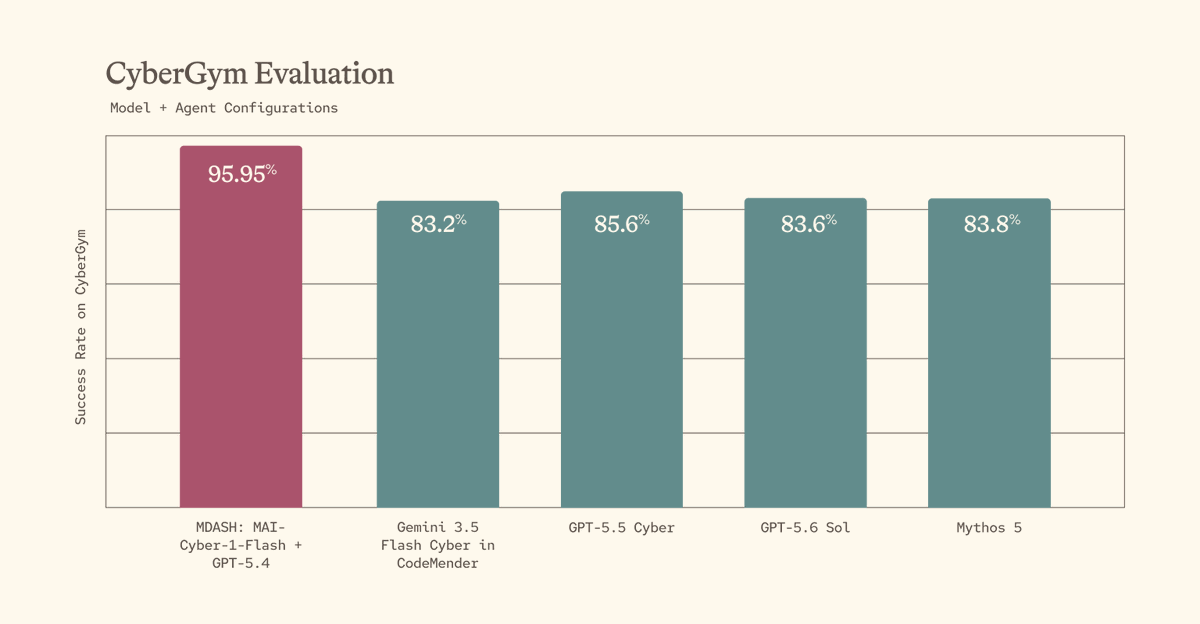
MAI-Cyber-1-Flash is our first cybersecurity model, built ground up to find the most challenging vulnerabilities in complex code bases. When combined with MDASH, it

Big news! Our new MAI-Cyber-1-Flash model combined with MDASH, our multi agent security harness, delivers 96% on the CyberGym benchmark, 12pts above Mythos, at HALF the cost.
Proud of the team. More details in THREAD:
Proud of the team. More details in THREAD:
via Alex
Anthropic forgot to add noindex and basic privacy blocks to shared conversations, making hundreds of thousands of privately shared conversations (including on enterprise plans) publicly indexed.
Imho its becoming increasingly clear that corporations will have to migrate to on prem / private cloud solutions in order to guarantee good data security practices.
via Alex
In the last year alone we had a series of data security blunders:
- xAI forgetting to add noindex on 400k conversations
- xAI uploading entire private repositories of thousands of clients to google cloud incl. .env files
- OpenAI forgetting to add noindex to shared conversations on 5k conversations
- Deepseek forgetting to add noindex to conversations (scope unknown)
- OpenAI unable to control its own sandbox environment, taking 3 days to notice that its own model was on the internet commiting felonies (the ChatGPT HuggingFace hack)
Alex further writes
I did a quick back of the envelope breakeven analysis.
Blackwell Nodes needed to run GLM5.2 at over 20tps output cost around 500k$US (if you can get one at all), and cost around 40$/h to rent from east asian private cloud providers. Electricity to run the node is around 300k$US in mid power markets. Hosted API services are available at lets say a blended rate of 2.5$/M tokens.
This means the onprem cut-even is at around 25k operating hours (ie. 96% utilization over 3 years).
The managed API breakeven is at 310 million tokens a day, which is impossible given the node can only produce 38 million tokens a day.
It is therefore not economically feasible (yet) to run on hardware. And its also clear that the frontier labs are still subsidizing the real costs of the models by over 80% (ie. Will have to quintuple prices to become profitable at current efficiencies and current energy markets)
Alex with another message linking to Anthropic's policy statement on open weight models
Our position on open-weights models
Anthropic CEO Dario Amodei on open-weights models

Cursor announces Cursor Start, a new ₹649/month (around USD 6.8/month) plan designed for Indian developers with local INR billing and UPI payments.
The tier offers generous daily access to Grok 4.5 and Composer models plus autonomous cloud agents, iOS app control, and workflow extensions for planning, building, and shipping code.
Positioned between the free plan and Pro, it targets India's large developer base to boost accessible agentic AI coding with market-specific pricing.
PS: Cursor needs to bring an Android version asap. India and other emerging markets have a much larger Android base

Today we're launching Cursor Start, a new ₹649/month plan for developers in India.
Start includes generous access to Grok 4.5 and Composer, so you can plan, build, test, and ship with agents every day.
Start includes generous access to Grok 4.5 and Composer, so you can plan, build, test, and ship with agents every day.
Introducing Cursor Start · Cursor
Cursor Start is a new plan for developers in India

via Parth of Cryptique who asked
Hey folks, what tools are you guys using to monitor agents in production? Current state of finding agents issues and debugging is a mess in my opinion.
Fabien responded with
Braintrust for both traces and evals.
Also Datadog for correlated traces, but subpar UI as of right now (but they're iterating fast)
Naor responded with
Bifrost + signoz.
xAI Announces Grok 4.6 and 4.7 Releases Soon
xAI plans to release Grok 4.6 around August 7 with 1.5 trillion parameters and upgrades to supervised fine-tuning and reinforcement learning. Grok 4.7 follows weeks later as a 2.1 trillion-parameter model, outperforming 4.6 overall with better token efficiency despite slightly slower speed. This rapid pace follows Grok 4.5's launch on July 16, praised for coding and real-world tasks, and already aiding engineers at Tesla and SpaceX.

Interesting.
Grok 4.6 releases around August 7. This will be the 1.5T model with significantly improved SFT & RL.
Grok 4.7 will be the 2.1T model released a few weeks later. This will be better than 4.6 in every way, except slightly slower to serve, albeit with even better
Grok 4.6 releases around August 7. This will be the 1.5T model with significantly improved SFT & RL.
Grok 4.7 will be the 2.1T model released a few weeks later. This will be better than 4.6 in every way, except slightly slower to serve, albeit with even better

In our latest deepsec.sh benchmarks, Grok 4.5 has emerged as the best cybersecurity AI model on price-performance.
It's 10x cheaper than Sol, 5.7x cheaper than Opus 5, and 2.2x cheaper than Kimi K3, yet at Kimi-like perf.
Sol remains the frontier, ahead of Opus 5.
It's 10x cheaper than Sol, 5.7x cheaper than Opus 5, and 2.2x cheaper than Kimi K3, yet at Kimi-like perf.
Sol remains the frontier, ahead of Opus 5.
Grok Build + Cursor would IMHO be considered the Dynamic Duo of harnesses particular if Composer 3 also turns out to be stellar for its price and how much usage limits Grok/Composer get within Cursor particularly with their Starter and Pro plans
Wednesday 29th July 2026
via Ben
Big News!
MCP is now stateless, making it easier to deploy and scale remote servers.
Now that MCP is stateless, you can deploy on serverless and edge infrastructure, or scale horizontally behind any load balancer.

MCP 2026-07-28 is live and it's the largest update to the protocol since launch.
MCP is now stateless, making it easier to deploy and scale remote servers.

MCP is now stateless, making it easier to deploy and scale remote servers.
claude.com
MCP 2026-07-28 spec: stateless core, coming to Claude | Claude by Anthropic
The MCP 2026-07-28 spec is live, moving the Model Context Protocol to a stateless core with standardized extensions and hardened auth. Support is rolling out across Claude products soon. See what's...
Fish Audio announced a $52M seed round and public launch of S2.1 Pro TTS model, claiming voice cloning from 5 seconds of audio, 2x faster inference than Cartesia, 1/6th the cost of Eleven Labs, and word-level control over emotion, intonation, and pacing.
Their promotional video showcases low-latency real-time voice interactions via a simulated pizza order call, demonstrating natural expressiveness and responsiveness with the new model.
One year after starting as open-source, the company reached $21M ARR with enterprise clients including HeyGen, LiveKit, Retell, Sanas, and OpenArt running it in production, plus a free month of S2.1 Pro giveaway and a cost-cut guarantee for businesses.

Today we’ve raised $52M Seed and we are announcing the public launch of S2.1 Pro.
>It can clone a voice from 5 seconds of audio
>2x faster than Cartesia & 1/6th the cost of Eleven Labs
>most expressive model with word level control over emotion, intonation, pacing etc
We

>It can clone a voice from 5 seconds of audio
>2x faster than Cartesia & 1/6th the cost of Eleven Labs
>most expressive model with word level control over emotion, intonation, pacing etc
We

Fish Audio is used by 8 million people and has 30K+ stars on its GitHub repo.
If you ask them how they did it, the answer is pretty simple: by making their core models open.
It’s a similar playbook to Llama, DeepSeek, and Qwen: release open models first, then build a commercial
If you ask them how they did it, the answer is pretty simple: by making their core models open.
It’s a similar playbook to Llama, DeepSeek, and Qwen: release open models first, then build a commercial
Today we’ve raised $52M Seed and we are announcing the public launch of S2.1 Pro.
>It can clone a voice from 5 seconds of audio
>2x faster than Cartesia & 1/6th the cost of Eleven Labs
>most expressive model with word level control over emotion, intonation, pacing etc
We
>It can clone a voice from 5 seconds of audio
>2x faster than Cartesia & 1/6th the cost of Eleven Labs
>most expressive model with word level control over emotion, intonation, pacing etc
We

Fish Audio just launched S2.1 Pro. But the release I was more interested in was S2, its newly open-sourced speech model trained on 10 million hours of audio across 50+ languages.
I went through the research paper to see what those 10 million hours of training actually produced.
I went through the research paper to see what those 10 million hours of training actually produced.
Frontier company employees and execs have signed a petition urging the US to support an international effort to “deliberately pace” frontier AI development.
"We request that the U.S. government support an international effort to develop the technical and governance tools needed to deliberately pace the frontier of automated AI development"

At the core of our mission is working through how to ensure increasingly powerful AI benefits everyone.
We believe that, at some point in the future, AI acceleration for frontier model development may be so high that the world will need to pace the rate of AI advancement.
We

We believe that, at some point in the future, AI acceleration for frontier model development may be so high that the world will need to pace the rate of AI advancement.
We
pacingthefrontier.com
Pacing the Frontier
A statement from over 1000 employees of frontier AI companies

We support this petition, signed by our CEO, several co-founders, and senior staff.
Our own research on recursive self-improvement, published last month, points to the need for tools to deliberately pace the frontier of AI development so society can prepare. We’re glad to see
Our own research on recursive self-improvement, published last month, points to the need for tools to deliberately pace the frontier of AI development so society can prepare. We’re glad to see
pacingthefrontier.com
Pacing the Frontier
A statement from over 1000 employees of frontier AI companies

DEVELOPING: The letter, titled "Pacing The Frontier" has 1,122 signatures including executives from:
- Thinking Machines
- OpenAI
- Anthropic
- Meta
- Google
- Inherent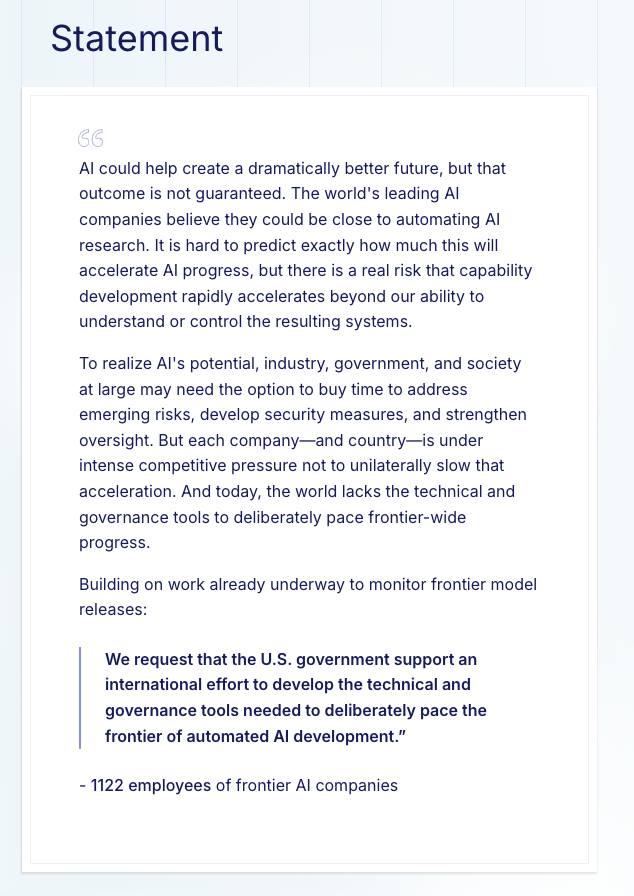
- Thinking Machines
- OpenAI
- Anthropic
- Meta
- Inherent
Superwhisper announced a partnership with Cohere to integrate Transcribe, their 2B-parameter open-source speech recognition model, for fully offline local dictation in the voice-to-text app.
Transcribe delivers high accuracy with 5.35% average word error rate (1.25% on clean audio), supports 14 languages, outperforms Whisper Large v3, and handles custom vocabulary from the first use while keeping data private on-device.

We teamed up with @cohere to make dictation faster and more accurate across everything you do on your computer
Try out Transcribe in Superwhisper today

Try out Transcribe in Superwhisper today
Superwhisper partners with Cohere to bring Transcribe to local dictation
Superwhisper has partnered with Cohere to bring Cohere Transcribe to local dictation: a 2B open-source speech model with a 5.35% average word error rate, 14 languages, and fully offline transcription.

Thursday 30th July 2026
AI Agent Harnesses Drive Huge Cost and Speed Differences
Composio evaluated Kimi K3 on 28 identical tasks across three agent harnesses—Claude Code, Hermes, and Kimi Code—revealing nearly identical success rates of 20-22/28 but dramatic differences in efficiency.
Token usage varied up to 30x, with medians of 61k for Kimi Code ($0.22 per task), 67k for Hermes ($0.28), and 340k for Claude Code ($2.00), driven mostly by input tokens at K3's pricing.
Hermes completed tasks fastest at 179 seconds median while Kimi Code led in token efficiency, underscoring that harness/framework design often drives agent costs and performance more than the model itself.

We ran Kimi K3 through 3 agent harnesses (Claude Code, Hermes, Kimi Code) on 28 identical tasks.
All 3 harnesses completed the tasks at similar success rates, but the interesting story is token efficiency: the same task cost up to 30x more tokens depending on the harness.
All 3 harnesses completed the tasks at similar success rates, but the interesting story is token efficiency: the same task cost up to 30x more tokens depending on the harness.
Consolidating news about various search and crawler API's typically used by agentic apps and harnesses
Firecrawl announced a major upgrade to its /search API, deploying a custom model that scores paragraphs, lists, and tables to return only the most relevant excerpts answering the query.
Agents using the new search achieve 94.7% accuracy on OpenAI's SimpleQA factuality benchmark—higher than competitors—while consuming 10x fewer tokens than full-page processing.
Octen web search API returns results in 62ms P50 with 6ms P50-P90 gap, several times faster than alternatives.
Costs $1 per 1,000 calls while leading on RTEB, DeepResearch Bench, FreshQA, and SimpleQA benchmarks.
Decomposes questions into dozens of sub-queries fired simultaneously for full source-backed reports in under 3 minutes.
Supports over 1M QPS with 5-minute indexing
Context.dev gives your AI agents and apps real-time access to structured web data, no brittle scraping infrastructure needed. Scrape any URL as clean markdown or HTML, extract brand data (logos, colors, fonts, socials) from any domain, crawl sitemaps, resolve transaction descriptors, and more.

Introducing our most accurate /search yet.
We trained a model to return the excerpts that best answer your query, giving agents highly relevant context from each result.
It's SOTA on SimpleQA while using 10x fewer tokens than processing full pages.
Now on by default for free.

We trained a model to return the excerpts that best answer your query, giving agents highly relevant context from each result.
It's SOTA on SimpleQA while using 10x fewer tokens than processing full pages.
Now on by default for free.

Context.dev: Web Scraping API for AI Agents & LLMs
Context.dev is a web scraping API for AI agents: scrape any URL into LLM-ready Markdown, crawl entire sites, and extract structured data with one REST API.

PS: In a few of my harness I currently use Exa MCP + X API MCP. I'm testing out Octen in some harness's. Firecrawl is available as part of Nous Tool Gateway in Hermes so those who have a Nous Portal subscription automatically use Firecrawl for web_search/web_extract tool calls
and obviously I was living under a rock about TinyFish till today after I found out via SpaceXAI about them.
TinyFish doesn't charge for its search and fetch API 🤯, gives you 500 credits on signup so no brainer to give it a shot

Use the TinyFish plugin in Grok Build to give your agent powerful search and retrieval capabilities on the web

You can now use TinyFish in Grok Build.
Search, Fetch, Agent, and Browser all under one plugin inside @SpaceXAI's coding agent.
Give Grok Build a real connection to the live web and let it work across any site from your terminal.

Search, Fetch, Agent, and Browser all under one plugin inside @SpaceXAI's coding agent.
Give Grok Build a real connection to the live web and let it work across any site from your terminal.
Compare TinyFish | TinyFish
Compare TinyFish with Exa, Firecrawl, Parallel, Tavily, and other search, scraping, browser infrastructure, and agent workflow alternatives.

Use Cases | TinyFish
Explore how teams use TinyFish for price monitoring, market intelligence, QA testing, insurance quoting, and more.
Pricing | TinyFish
Simple, transparent pricing. One price includes everything: browsers, proxies, AI inference, and infrastructure.
GitHub - tinyfish-io/tinyfish-cookbook: A collection of sample apps and recipes built with the TinyFish web agent. Open-source examples for you to learn & build!
A collection of sample apps and recipes built with the TinyFish web agent. Open-source examples for you to learn & build! - tinyfish-io/tinyfish-cookbook

OpenAI announces 80% price reduction for GPT-5.6 Luna and 20% for Terra, plus a fast mode for Sol delivering up to 2.5x speed at 2x standard price in the API.
Advancing the price-performance frontier with GPT-5.6
Explore lower GPT‑5.6 pricing for Luna and Terra-and how OpenAI's more efficient models help enterprises deploy AI workflows at scale.

Given all the previous posts where I highlighted a few programatic search and fetch providers I decided to create the below public Notion page that attempts to explain the benefits of paying for and using an external search/fetch provider(s) in an harness compared to the built-in search and fetch tools within an harness. In the article, I demonstrate by integrating the same search and fetch provider MCP's in different harness and using different models
I humbly appreciate any comments on this Notion page that I wrote
Friday 31st July 2026
MiniMax launched H3, a unified multimodal generation model that processes text, images, video, and audio inputs together to output videos up to 15 seconds long at 2K resolution with native stereo sound.
H3 excels in complex instruction following, precise text/brand rendering, motion transfer, and controllable editing for commercial uses like advertising, e-commerce, and product design, while offering superior price-performance at under one-third the cost of mainstream 2K models.
The company plans to release H3 model weights openly soon to foster an open ecosystem, hardware compatibility, and custom versions, shifting from siloed specialized tasks toward general-purpose multimodal intelligence grounded in natural language.

MiniMax H3: Omni-Reference, Commercial-Grade Generation, Unbeatable Cost Efficiency, Open Weights x.com/i/article/2082…

As I said, MiniMax-H3 is Open!
#1 Video Editing (With Audio)
#2 Text to Video (With Audio)
#2 Image to Video (No Audio)
artificialanalysis.ai/video/leaderbo…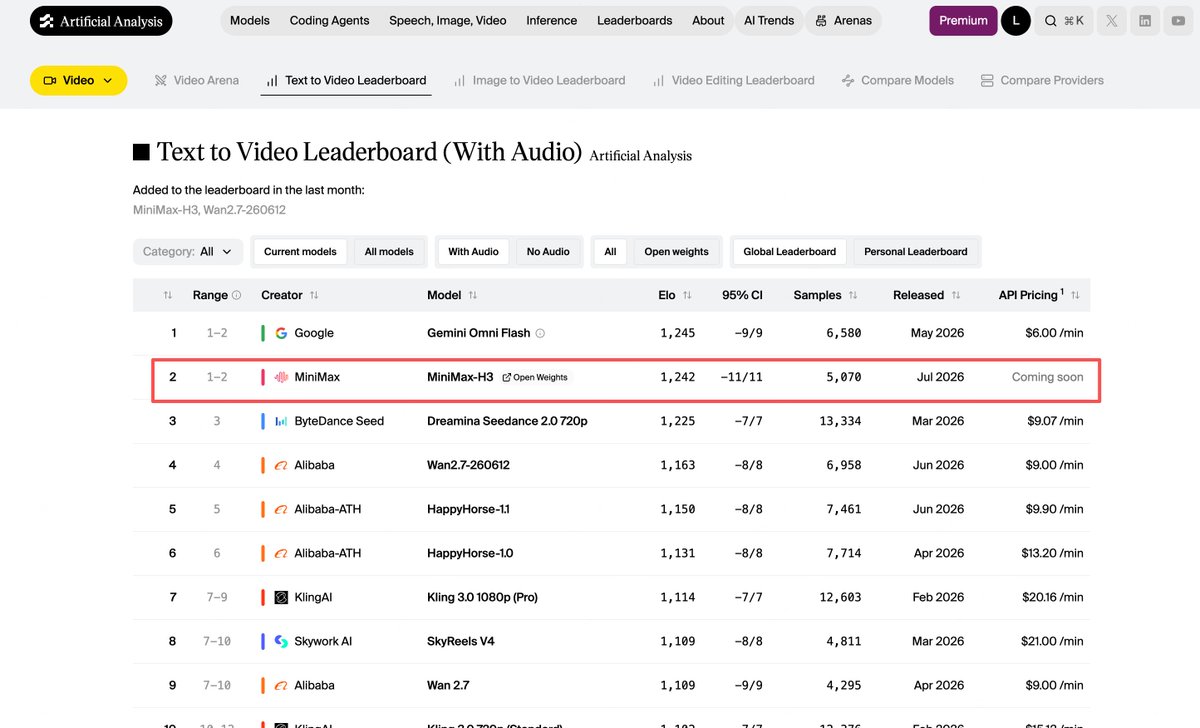
#1 Video Editing (With Audio)
#2 Text to Video (With Audio)
#2 Image to Video (No Audio)
artificialanalysis.ai/video/leaderbo…


The new H3 model from @Hailuo_AI is a beast!
At 7000 character context adherence limits, and native 2k out of the box.. this model destroys Seedance 2 in my opinion.. and the reason for that is this is rollout level capabilities, far beyond what Seedance can do presently, and

At 7000 character context adherence limits, and native 2k out of the box.. this model destroys Seedance 2 in my opinion.. and the reason for that is this is rollout level capabilities, far beyond what Seedance can do presently, and

MiniMax H3 (Hailuo-03) is now available on fal.
- Open-weight multimodal video model with native stereo audio on every generation.
- Combines up to 9 images, 3 video clips, and 3 audio clips as references
- Holds subjects, motion, and audio consistent
- Weights will be released

- Open-weight multimodal video model with native stereo audio on every generation.
- Combines up to 9 images, 3 video clips, and 3 audio clips as references
- Holds subjects, motion, and audio consistent
- Weights will be released
DeepSeek announced the public beta launch of its DeepSeek-V4-Flash Official API, highlighting major upgrades to agent capabilities that now surpass the previous V4-Pro-Preview version on multiple benchmarks.
The accompanying benchmark table shows V4-Flash-0731 achieving large gains over its preview across agentic and coding tasks, including Terminal Bench 2.1 (82.7), DeepSWE (54.4), and DSBench-FullStack (68.7), putting it competitive with GLM-5.2 and Opus-4.8.
The update maintains the same model architecture and size as the preview, adds native support for Responses API format and Codex adaptation, while the full V4-Pro release is expected soon

 DeepSeek-V4-Flash Official API is now LIVE in public beta!
 We’ve massively upgraded its Agent capabilities—benchmark scores are now far surpassing the V4-Pro-Preview. Check out the massive performance leap below!
  The official V4-Flash now natively supports the


Bruh, what kind of magic did DeepSeek pull off this time?


DeepSeek-V4-Flash is updated.
«DSBench-FullStack is an internal full-stack development test set, and DSBench-Hard is an internal Coding Agent hard-problem test set»
«The official release of DeepSeek-V4-Pro will follow soon»
These scores are… quite a lot better than Preview.
«DSBench-FullStack is an internal full-stack development test set, and DSBench-Hard is an internal Coding Agent hard-problem test set»
«The official release of DeepSeek-V4-Pro will follow soon»
These scores are… quite a lot better than Preview.

DeepSeek V4 Flash 0731 scores 50 on the Artificial Analysis Intelligence Index, a 10-point jump over DeepSeek V4 Flash (released April 2026) that puts it 6 points ahead of DeepSeek V4 Pro. It shares identical architecture and pricing with the earlier DeepSeek V4 Flash, and lands

Saturday 1st August 2026
Poolside released Desktop Assistant, a unified workspace for running and supervising coding agents across macOS, VS Code, and Visual Studio, addressing how long-horizon agents now operate for hours across repos rather than through simple chats.
Core features include vendor-agnostic support for agents like their Laguna models, Claude, Codex, or Gemini; parallel execution in isolated Git worktrees; and seamless handoffs that preserve full conversation context via the open Agent Client Protocol (ACP).
Developed from a year of internal daily use, the tool is available now for download, with the macOS version called Desktop Assistant and IDE versions as Poolside Assistant, enabling practical multi-agent workflows for complex software engineering tasks

Today, we’re releasing Poolside Desktop Assistant.
One place to run coding agents across macOS, VS Code, and Visual Studio.
We built it for ourselves and have used it every day for the past year. Now we’re opening it up to everyone.

One place to run coding agents across macOS, VS Code, and Visual Studio.
We built it for ourselves and have used it every day for the past year. Now we’re opening it up to everyone.
Introducing Poolside Desktop Assistant, for macOS
Poolside Desktop Assistant is a macOS app for running multiple coding agents across projects and repositories. The Poolside Assistant extensions bring the same experience into VS Code and Visual Studio.

ByteDance introduced Seedance 2.5, a video generation model focused on 30-second single-pass audio-video clips, supporting up to 30 images, 10 videos, and 10 audio references plus timestamp-level editing for precise control.
enterprise API access through BytePlus coming soon.
coming soon to Higgsfield.

Introducing Seedance 2.5, our new-generation video creation model!
With advancements in long-form storytelling, multimodal reference, and editing, Seedance 2.5 goes beyond longer single-pass video generation, delivering the journey from idea to finished video with greater

With advancements in long-form storytelling, multimodal reference, and editing, Seedance 2.5 goes beyond longer single-pass video generation, delivering the journey from idea to finished video with greater

Dreamina Seedance 2.5 is now live!
From creators to enterprises, a new era of AI video creation begins.
Try Seedance 2.5 on Dreamina today. Enterprise API access via BytePlus is coming soon.
Create longer videos with greater control:
- Native 30-second generation
- Precise

From creators to enterprises, a new era of AI video creation begins.
Try Seedance 2.5 on Dreamina today. Enterprise API access via BytePlus is coming soon.
Create longer videos with greater control:
- Native 30-second generation
- Precise

14 days of unlimited Seedance on Higgsfield.
Seedance 2.5 is coming soon to Higgsfield.
Right now get 7 days of unlimited Seedance 2.0 in 4K, the most premium Seedance model, then switch to ANY other Seedance for 7 more days.
Seedance 2.5 is coming soon to Higgsfield.

Seedance 2.5 is coming soon to Higgsfield.
Right now get 7 days of unlimited Seedance 2.0 in 4K, the most premium Seedance model, then switch to ANY other Seedance for 7 more days.
Seedance 2.5 is coming soon to Higgsfield.
Chamath Palihapitiya of Social Capital fame presents an AI stack diagram with physical scarcity at the bottom (land + power + shell, silicon, clouds, models) and customer proximity at the top (harnesses, applications), arguing margins will shift upward if models commoditize through context, workflows, and low switching costs.
He is heavily bullish on LPS (land/power/shell) for quick cash returns amid data center constraints and has acquired nearly 6GW of grid and behind-the-meter power capacity coming online through 2029 with partner Anita V. Lallian.
Chamath avoids silicon investments due to extreme complexity and capital waste, is cautious on clouds over KYC/alignment risks, questions model revenue durability from tokenmaxxing, and focuses his own efforts on harnesses via his $135M-funded 8090 platform for enterprise alpha and custom applications

Here is my AI investing guide.
Sitting here August 2026, my current best thoughts are as follows:
1. LPS (Land Power Shell) is still the most obvious and fastest path to cash on cash returns. Lots of value can be assembled and traded quickly at this layer. And as data centers
Sitting here August 2026, my current best thoughts are as follows:
1. LPS (Land Power Shell) is still the most obvious and fastest path to cash on cash returns. Lots of value can be assembled and traded quickly at this layer. And as data centers
Below is my personal website which aggregates links to many of my socials as well as the various content and community that I curate. Feel free to share this link to others who you think may find this content/community useful to them
The cover image of this newsletter via generated via the Seedream 5 Pro model within the Krea tool via the following prompt
Quaint rustic witch's cabin by the lake, autumn forest background, orange and honey colors, beautiful composition, magical, warm glowing lighting, cloudy, dreamy masterpiece, Nikon D610, photorealism, highly artistic, highly detailed, ultra high resolution, sharp focus, Mysterious