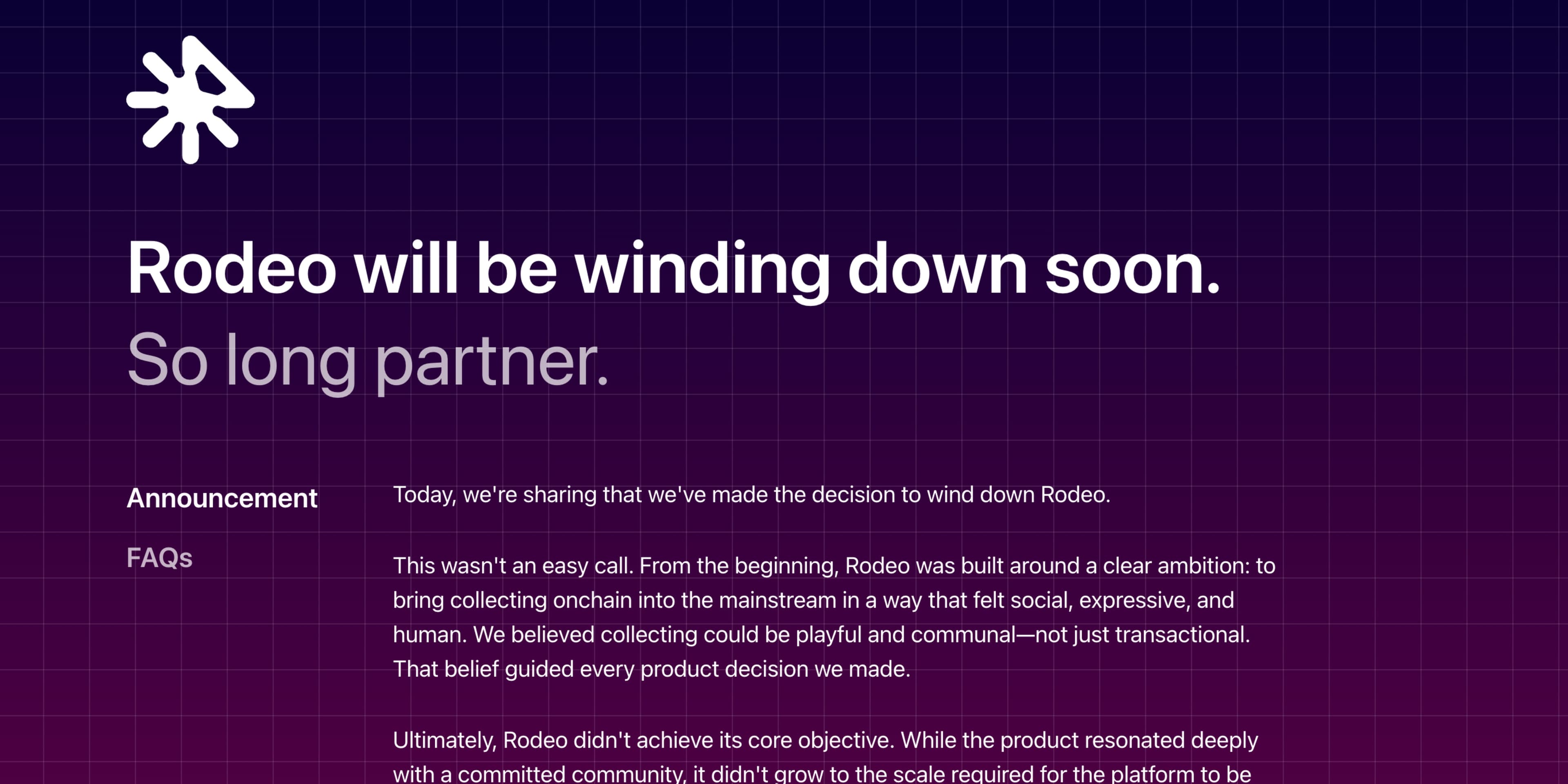
Over the past months, several NFT platforms have announced their closure or slow wind-down. This week, I personally withdrew my remaining NFTs from Nifty Gateway and I’m currently in the process of wrapping up with Rodeo.
When platforms shut down, the immediate reaction is panic, followed by declarations that “NFTs are dead.” That reaction usually comes from the same place that fueled the hype in the first place: a focus on platforms, liquidity, and speculation — not on art.
From an art perspective, something else is happening.
One of the reasons I never fully embraced Nifty Gateway was custody. The artist didn’t deploy the contract, didn’t control minting, and ultimately didn’t control the long-term fate of the work. During the hype cycle, that felt acceptable. In hindsight, it wasn’t.
Provenance matters. Not as a buzzword, but as a foundation. If the artist doesn’t mint from their own contract, authorship is already mediated by infrastructure that may not survive the next market cycle. Platform shutdowns expose this fragility very clearly.
If NFTs are to be taken seriously as part of art history — not just as collectibles — custody cannot be optional.
Rodeo did many things right. Its social feed genuinely worked. Fixed pricing with a 24-hour counter created urgency without auctions. I discovered many artists there and collected works I still care deeply about.
I loved my time on Rodeo.
At the same time, the platform naturally encouraged experimentation over completion. I found myself publishing ideas, tests, and fragments more than fully resolved works. The feedback loop was fast and rewarding, but it subtly shifted my focus away from depth.
This isn’t a failure — it’s a design choice. Rodeo optimized for flow, discovery, and play. As an artist, I had to eventually step back and ask whether that rhythm aligned with the kind of practice I wanted to sustain long term.


Tezos is not dead for me. I moved away for different reasons.
It became a space largely driven by artists collecting other artists, often at very accessible price points. There’s generosity there, and a strong experimental spirit. But visibility doesn’t come easily. Minting alone does nothing.
To gain traction, artists need to constantly share on X or push their work through group chats and DMs. I never enjoyed that. I hate spamming people. When my reach on X collapsed, the entire visibility loop collapsed with it — and that’s ultimately what made me pause minting on Tezos.
Still, I’m reconsidering it as a space for experimentation again, precisely because it exists outside the current financialized attention economy.
On ETH and Base, social layers like Farcaster and the Base app have increasingly shifted toward trading behavior. Attention is priced. Momentum is monetized. Art becomes a wrapper for engagement.
Zora sits at the center of this tension. It looks like art, but it doesn’t behave like art. Tokenized posts, visuals that don’t even register as artworks in wallets, and a system that prioritizes circulation over context. I’m not dismissing it — but I am confused by it, and that confusion feels important.
This isn’t an art-native system. It’s a social-token economy borrowing art’s surface language.
MoMA has held NFTs in its collection for some time, but its recent acquisitions — donated works formally accepted and curated by the museum’s board — marked a turning point. Museums don’t chase hype. They contextualize movements once they matter historically.
That signal is important.
Art NFTs are no longer primarily seen as trading assets — and that’s not a failure. Speculation moved on to memecoins, gaming, and financial primitives. What remains is quieter, slower, and more demanding.
Fewer platforms. Less visibility. More responsibility on the artist.
Recently, I was asked on a podcast: Where should artists mint today?
The honest answer is no longer a platform name.
It’s a set of questions:
Who controls the contract?
What kind of practice am I building?
Do I want visibility or depth — and at what cost?
Will this infrastructure still exist in five years?
NFTs as an art movement didn’t die. Platforms optimized for hype couldn’t survive. What’s left is harder — but also more honest.
And that might be the first real chance this medium has had to grow up.
Fer Caggiano
mom, artist, curator, Art & Web3 consultant
fercaggiano.art
Over 200 subscribers



 179
179


Art will never be dead. Platforms will never dictate the journey of artists. Great share @fercaggiano
Thanks for sharing 🫂💙
good article from @fercaggiano expressing artist/collector market sentiment at this moment. https://paragraph.com/@fercaggiano/nft-platforms-are-closing
Thanks for sharing 💙
New article on my paragraph blog. NFT Platforms Are Closing But NFT Art Isn’t Dead
Thanks fpr share darling ✨
Thanks for reading 🥰
♥️🫂
🫂💙
Never surrender 🔥 Nifty down too 🙌 55555 $TYSM
Yes! I mentioned NG in the article as well. I had a few pieces in there and I've already withdrawal them. It is sad that with custodial wallets and platform contracts, when they close, some people may not be active and will lose their assets. 42069 $TYSM
All I can say is bravo to platforms that boasted about preserving digital art forever and can't even maintain a site for more than 5 years. It reeks of a major failure by the way...a big lose of course in all sense of the term 🫰